The box says "4–10 players". It is lying about the four.
Almost every party game has a real number and a marketing number. The marketing number is on the box. The real number is the one below which the game stops doing the thing it was designed to do, and for most of the famous ones it is seven or eight.
This matters because four to six is the group most of us actually have. Not the group in the recommended-players box — the group that replies to the message on Friday afternoon.
So: what fails at five, why, and what works instead.
Why big-group games break at five
Three separate failure modes, worth being able to spot.
The hidden role stops hiding. In a group of ten, one traitor is a needle in a haystack. In a group of five, it is one of four people and the search space is small enough to brute-force. Games balanced around uncertainty become games of elimination-by-arithmetic.
The moderator tax becomes unpayable. Losing one person to running the game costs you a ninth of a group of nine. It costs you a fifth of a group of five, and that fifth is usually the person who owns the game and understands it best.
Every silence is your silence. In a big group there is always someone else talking. At a table of five, if you have nothing to say, the room notices, and the game had better be handing you material.
Hold those three up against any game and you can predict how it does at a small table without playing it.
The big ones, honestly assessed
Mafia and Werewolf. Fail on all three. One person moderates, the traitor is findable by counting, and eliminated players sit out. Real minimum is around eight, and eight is optimistic.
Codenames. Works at four and is excellent, but it is a word puzzle in a party-game costume. There is no bluffing and nothing social happening beyond the clue. Great for an hour, not an evening.
Cards Against Humanity and its descendants. Technically work at four. The problem is that the game does not change over its length — round twenty is round two with different cards — and at a small table you exhaust the group's sense of humour faster because you see everyone's cards more often.
Wavelength. Genuinely good at four to six and underrated. Two teams, a dial, and an argument about where "underrated" sits between "obscure" and "famous". Short rounds, no elimination, no moderator. The limitation is that it has no memory: nothing that happened in round three matters in round seven.
The Resistance / Avalon. Better than Mafia because nobody is eliminated — failed missions cost the team, not a player. Still wants seven or more before the hidden roles hide properly, and at five the deduction collapses quickly.
Spyfall. Works at four, no moderator, nobody out. A good, genuinely small-group game. It is a mechanism rather than a story, so after a few rounds the group has learned the trick and it becomes a warm-up rather than a main event.
Just One and similar co-ops. Fine at four to six, pleasant, low-stakes. Nobody has ever argued about a game of Just One in a taxi.
What a small table is actually good at
Here is the thing the "4–10" boxes get backwards. A table of five is not a worse version of a table of ten. It is a different, and in some ways better, social situation.
Everyone can see everyone's face. There are no side conversations. Nobody can hide in the crowd, which means nobody can coast — and it also means nobody gets overlooked, which is the real problem with big groups and quiet friends.
A game designed for that is not a scaled-down big game. It is a game where every person is load-bearing.
Games built for the small table
Wavelength — 4+, twenty minutes a session, no setup. The best pure filler on this list.
Spyfall — 4+, ten minutes a round. Buy it, keep it in a drawer.
One Night Ultimate Werewolf — 3+, ten minutes. Solves elimination by ending before it can happen. A brilliant short game and unambiguously a short game.
Hanabi — 2–5, co-operative, and the small count is a feature rather than a compromise. Not a party game exactly, but the right thing for a quiet four.
A written murder mystery, if it is written for four. Which is what we do, so treat the next section as the biased part.
The case for a case
We built Guilty Party because the gap on that list was obvious. Everything that works at four to six is short and has no story. Everything with a story and characters wants eight people and a moderator.
The design targets the three failure modes directly.
No moderator. The evening's structure lives in the case's own data rather than in a person's head. Acts open cards on every phone; between them a dossier lands on all the phones at once with a fresh fact about each person in the room. Somebody taps to move it along when a conversation runs dry, and that somebody has a character and three cards like everybody else.
No elimination. Between acts the table votes openly on who looks worst. Everyone sees who pointed at whom. Nobody leaves — the cost is that you begin the next act defending yourself, which is a much better fate than watching.
Nobody runs out of material. Each of the three acts opens a new card for every single player. And the shared dossier burns everyone in every round, by construction: if it marked three people out of six, the table would simply stop considering the other three.
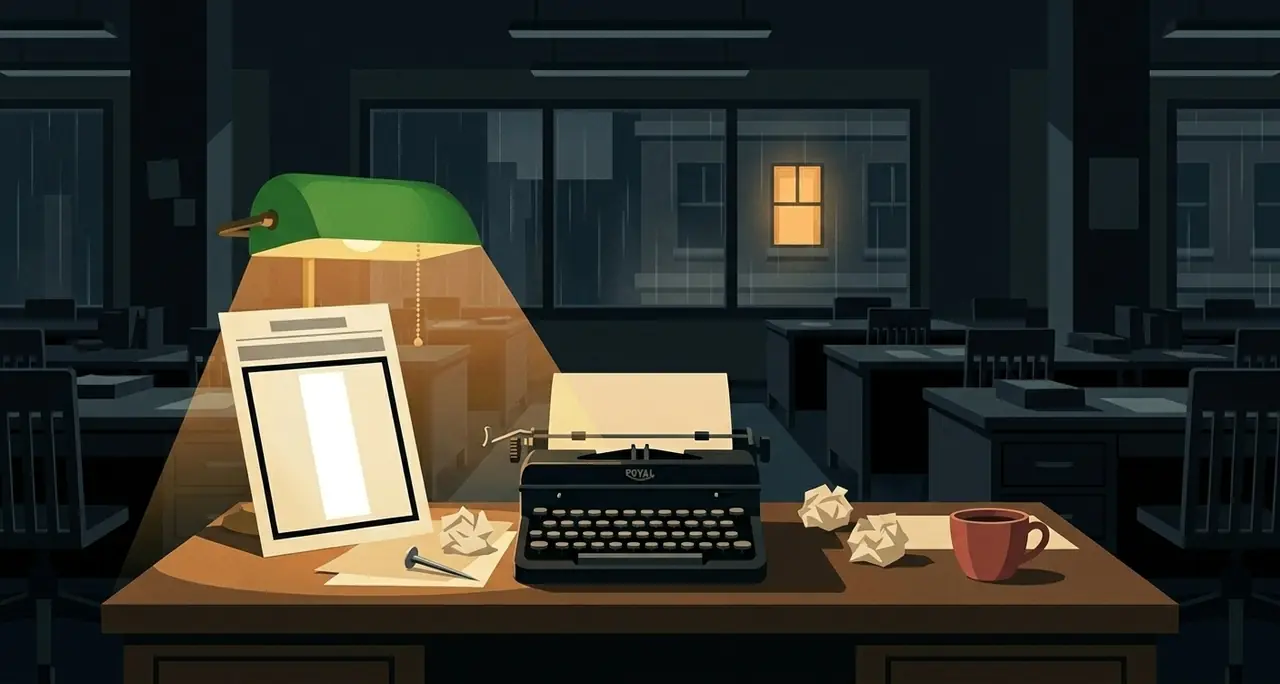
Two of the cases are written for exactly four people rather than trimmed down from six. The Final Edition is a night newsroom in New York in 1948. The Second Set is Paris in 1949, an impresario in the Seine, and a master disc that never left the building. In a four-hander there are three innocents, so the case carries exactly three load-bearing threads, one each, and the dossier has to burn all four people every round without exception. That is a genuinely different construction, and it is why a six-player case with two characters deleted does not work.
The honest limitations
It is worth saying what this is not.
You play a case once. After the resolution everyone knows the answer. Wavelength you can play every week; a case is an episode. Eleven of them exist and more get written, but if you want one purchase that lasts a year, buy Wavelength.
It needs everyone online. Phones share a room through a server. No connection, no evening.
It runs about half an hour. That is a main event, not a filler, and it is also not a whole night. The natural shape is a case followed by something short, or dinner followed by a case.
A running order for five people
If you want a whole evening rather than one game, this shape works.
Start with Wavelength while the last person is still on their way. It absorbs latecomers without penalty, which almost nothing else does.
Do the case as the centrepiece, once everyone has a drink and has stopped checking their phone for work reasons. Half an hour of game and — reliably — half an hour of argument afterwards.
Finish with Spyfall or One Night, short rounds, while people decide whether they are staying.
The case is the part people will bring up next time. The other two are there so the evening has a beginning and an end.
On a night when the same group wants to play without sitting down to a case at all, try Hidden Agenda, from the studio that makes Guilty Party. Everyone gets three secret missions to pull off mid-conversation, and it plays free in the browser, so the evening stays a party and the game runs underneath it.
The one-line version
Stop reading the recommended-player count on the box and start asking a different question: at five people, does this game still hide anything, does it still hand everyone something to say, and does it still let everyone play?
Most of them answer no to at least one. The ones that answer yes to all three are worth keeping.