Most murder mystery dinner parties die three days before the dinner.
They do not die at the table. They die at the printer, at 23:40, when the host discovers that the character packet is forty-one pages and the colour cartridge is out. Everything after that is triage. You print in black and white. You skip the name badges. You read the introduction aloud from a phone because the first page came out with a grey band down it.
That is the real problem with the boxed murder mystery. The game is usually fine. The preparation is a second, unpaid job, and it lands entirely on one person — the person who most wanted to play.
This is a guide to hosting the same evening without that job.
What actually has to happen
Strip a murder mystery dinner down and there are only four requirements.
Everyone needs a character they understand in under a minute. Everyone needs something to say that other people want to hear. Information has to arrive in stages, so that the conversation at 22:00 is not the conversation at 21:15. And at the end, everyone has to commit to an answer.
Everything else — the printed dossiers, the costume suggestions, the name cards in copperplate — is decoration. Decoration is lovely and it is also the entire source of the workload. Cut it and the evening still works.
The running order
Here is a shape that holds for six people and about two and a half hours, dinner included.
19:30 — people arrive. Do not start the mystery. Feed people something and let them talk about their week. A murder mystery that begins while three guests are still taking their coats off never recovers; the two who arrived early have already formed a theory and the latecomers spend the night behind. If the room is slow to warm up, a round of never have I ever gets people talking without starting anything.
20:00 — everyone gets their character. This is the moment to protect. Each person needs five quiet minutes to read who they are, and they need to read it alone, not while someone explains it to them. Give them the five minutes. Pour something. Do not talk over it.
20:15 — the first act, over the starter. The first course is the best possible cover for the awkward opening. Nobody has to perform, because everyone is holding a fork. People introduce themselves in character between bites, which is a much lower bar than standing up and doing an accent.
20:45 — the first piece of new information. Something has to change. A fact appears that none of the characters knew, and it has to be about the people in the room rather than about the plot in the abstract. "The safe was opened with a key" is plot. "The safe was opened with a key, and three of you had one" is an evening.
21:15 — main course, second act. By now the table has a suspect. This is the point at which the game either accelerates or stalls, and it stalls when the accused has nothing left to say. Whatever system you use, the second act has to hand people new material, not just more time.
21:45 — third act and the last revelation. Everything the table needs is now on the table. Nobody has been given the answer.
22:00 — everyone accuses. In writing, or simultaneously, or on a phone. The one thing that must not happen is a show of hands, because a show of hands is just a vote for whatever the most confident person said thirty seconds earlier.
22:10 — the resolution. Then dessert, and forty minutes of "I knew it was you" that is, honestly, the best part of the night.
What to cook
Cook something you have made before.
That sentence is the entire food section, but here is the reasoning. You are going to be watching six people, moving the evening along, and enjoying yourself. You cannot also be timing a soufflé. Anything that needs attention between 20:00 and 22:00 is going to lose.
Practically: one thing in the oven that looks after itself, one thing that was finished before anyone arrived, and a dessert from a shop. A braise, a big tray of roast vegetables, and a tart. Nobody at a murder mystery has ever complained about the tart.
Serve the starter as something people can pick at while they read their characters. Grazing food removes the pressure to perform in the first ten minutes, which is the hardest ten minutes of the night.
And keep the table clear enough that people can see each other. This is a game about faces. If there is a candelabra between two guests, those two guests are effectively not playing together.
The seating actually matters
Put the two people who know each other best at opposite ends. They will find each other anyway, and separating them spreads the conversation across the whole table rather than into two private ones.
Put the quietest person somewhere with a natural neighbour rather than at the head of the table. The head of the table is an exposed position, and an exposed position is where a shy player goes silent for an hour.
Skipping the packet entirely
Everything above assumes you are still assembling the material. You do not have to be.
The reason we built Guilty Party is that the printing was the only part of a murder mystery night that anyone dreaded. The characters, the staged information and the final accusation all live on the phones already in the room. One person picks a case. Everyone else scans a QR code, and a page opens in their browser — no app to install, no account, no email address.
Nobody reads a script aloud, so nobody has to be the host who does not get to play. And nobody is eliminated, which means the person the table accused over the starter is still arguing with everyone over the main course.
If there is no dinner at all, the zero-prep guide walks through the same evening starting from a decision made ten minutes earlier.
Choosing a case for a dinner
A dinner is not the same as a games night, and some cases suit it better.
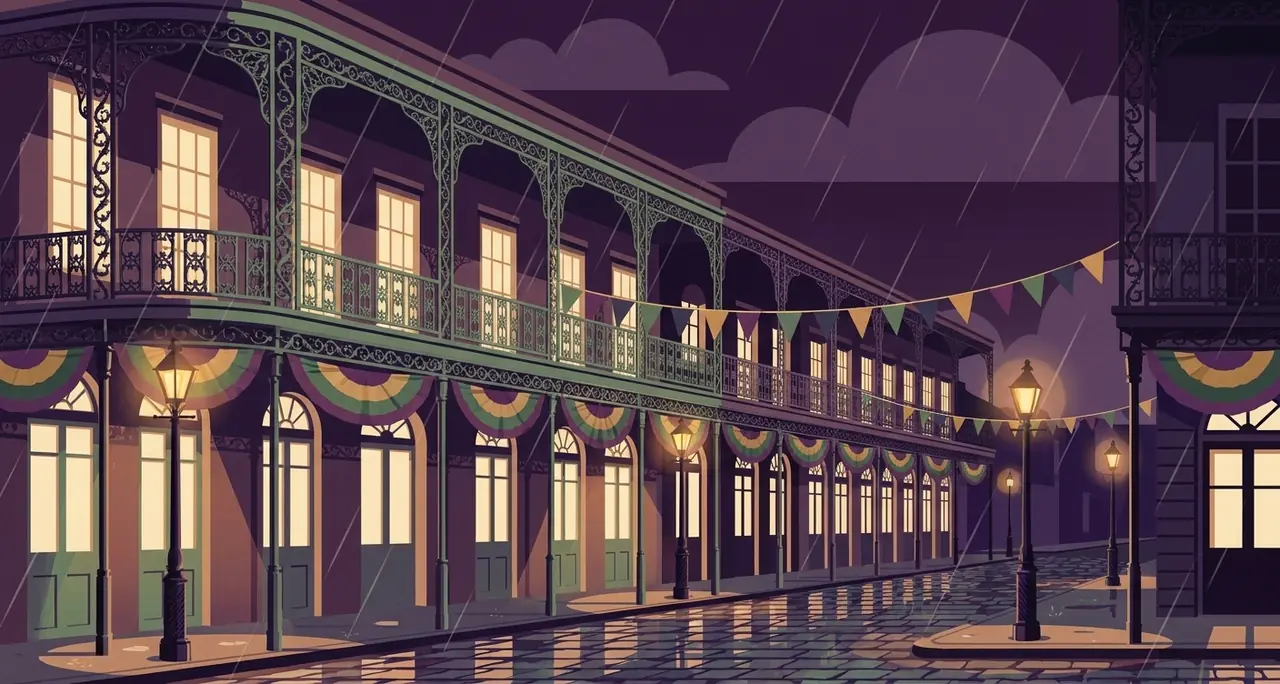
You want a case where the setting sits near a dinner table. The Eclipse is a house party on the Riviera and drops straight into a room where people are eating. The King Cake is a Twelfth Night ball in New Orleans in 1926 and comes with its own dessert, which is either charming or too much depending on how literal you feel.
If your table is four rather than six — and most dinner tables are — The Final Edition and The Second Set are written for exactly four people, with the plot tightened to match rather than a six-person case with two characters removed. That distinction matters more than it sounds. A six-hander missing two people has holes in it, and the table finds them.
The two mistakes hosts keep making
Explaining too much at the start. The urge to give a full briefing is strong and it is wrong. People do not retain rules they have not needed yet. Tell them the one rule that governs behaviour — in our case, you may hide things, you may not invent them — and let the rest arrive when it becomes relevant.
Refereeing. If you are hosting and you find yourself adjudicating whether something someone said was allowed, the evening has quietly become your job again. Build the evening so the rules do not need a referee, or accept in advance that you are running it rather than playing it. Both are fine. Discovering it at 21:30 is not.
The short version
A murder mystery dinner is not hard. It is only laborious, and only in the preparation. Cut the preparation and what is left is six people at a table lying to each other about a diamond, which is one of the better ways to spend a Saturday.
Cook something you have made before. Give people five quiet minutes with their character. Stage the information. Make everyone commit to an answer at the same moment.
Then let the argument run into the taxi home.