
The best murder mystery party ideas are small and specific: one year for the theme, one lamp instead of the ceiling light, one costume detail per guest, and a format where nobody has to sit out holding the script. Here are 24, grouped by the problem each one solves. Take three and the evening is already better than most.
Before the night
1. Put the year on the invitation
The invitation needs the date, the year the case is set in, and a line asking each guest to bring one thing to wear from it. Leave the characters out. Guests who get a character booklet in advance either over-prepare or don't read it, and both show at the table.
2. Warm up while people arrive
The first twenty minutes are coats and drinks. A quick round of would you rather or two truths and a lie gets people talking before anyone has a character to protect. Two truths is the better warm-up for a mystery: it is lying practice with nothing at stake.
Themes
3. Pick a year, and let it decide everything
"Murder mystery" is a genre. "Paris, 1927" is a party. A year tells guests what to wear and tells you what to pour and what to play, so every small decision is made before you start. Pick one from before anyone at the table was born.
4. Set it anywhere except where you are
The quickest way to make a mystery awkward is to set it at a wedding, an office or a flat like yours. Guests start hearing the plot as gossip about each other. A night train, a Nile dig, a film shoot on a Greek island: pick somewhere nobody at the table has been, and every accusation lands on a character.
5. The night train
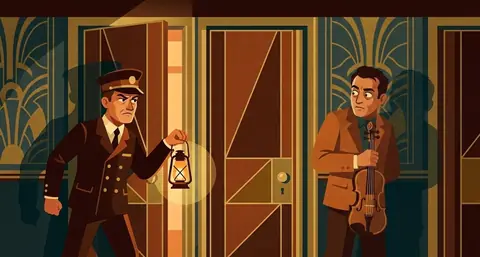
Tickets as place cards, a timetable taped to the door, the lights dimmed for a tunnel. A sleeping car is the classic closed room, because nobody gets off between stations. The Northern Express is the Paris to Budapest night train in October 1927, with a Stradivari gone after four minutes in a tunnel.
6. A villa on the Riviera
A white tablecloth, a bowl of lemons, dance records from the twenties. The Riviera between the wars is the most forgiving theme there is, because one linen jacket or one silk scarf already counts as a costume. The Eclipse, the free case, is a villa party in August 1928.
7. Twelfth Night with a real king cake
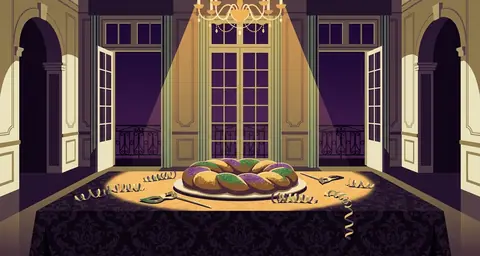
Buy or bake a king cake with a bean inside, and whoever finds it in their slice opens the room. It is a New Orleans carnival tradition, and it turns cutting the cake into the start of the game. The King Cake is set at a Twelfth Night ball in 1926.

Formats
8. The dinner version
Run the acts over the courses: the first act with the starter, the second with the main, the accusation before dessert. The meal and the game stop fighting over the same twenty minutes, and nobody has to perform with an empty plate. The dinner party guide has a full running order and a menu that cooks itself.
9. The video call version
A mystery works over a call when each guest's secret lives on their own phone instead of on a shared board. Guests join by link instead of scanning a code across the room. The video call guide covers mixed tables, where half the group is in the room and half is on a screen.
10. The version with no host
In a boxed kit, somebody holds the answer and spends the evening running the game for everyone else. Guilty Party moves that job onto the phones: the app deals the characters and drops the dossiers, and the person who taps on to the next act is a suspect like everyone else.
11. The party where half the room won't sit down
If half your guests came to talk and not to play, skip the table. Hidden Agenda, from the same studio as Guilty Party, gives every guest three secret missions to pull off mid-conversation, and it plays free in the browser. The room thinks it is an ordinary party until somebody slips.
12. Two tables for eight
With eight guests, split into two tables of four with two different cases, then compare verdicts over dessert. At one table of eight, half the room waits while the other half talks. Two tables of four keep everyone talking the whole time.
Props in five minutes
13. Turn off the ceiling light
Put one lamp in the middle of the table and switch the big light off. It takes ten seconds and makes an ordinary room look like somewhere with a secret. Candles work too, as long as nobody reaches across them.
14. Name cards, written after the deal
Once the characters are dealt, everyone writes their character's name on a folded card and stands it in front of their plate. Six new names are hard to hold in your head, and a card means nobody spends the second act asking who the baron was.
15. A notepad and a pencil each
The guests who write things down argue better, and the argument is the best part of the night. A pencil and a small notebook also pass for a prop from any decade.
16. A playlist from the year
Search for dance music or radio from your year and let it run low. Pick instrumental music, so it never competes with the talk. It fills the silences in the first ten minutes, which are the hardest ten minutes of the night.
17. A bell between acts
Whoever taps on to the next act rings a small bell first. Side conversations stop faster for a bell than for a polite request, and it gives the evening a rhythm people start waiting for.
Small tables
18. Treat four as a full table
Four people make a complete game. Two of the cases, The Final Edition and The Second Set, are written for exactly four, so every character carries more of the plot and nobody can hide in a corner of it.
19. A weeknight mystery
The game itself takes about half an hour, which fits after dinner on a Wednesday. A mystery needs four people, a table and a phone each. The costume budget and the Saturday night are optional.
20. Sit at the kitchen table
Sit where everyone can see everyone's face. On a sofa, people talk to whoever is next to them. Around a table, they talk to the suspect across it, and that is where the good moments happen.
The second time
21. Switch from a theft to a death
The Eclipse is a theft: a famous diamond turns out to be glass. Most of the other cases open with a death, and a table plays those differently, more carefully and with more at stake. If your group started with one kind, try the other next.
22. Hand the room to the most accused player
Whoever the table accused most last time opens the room this time. It gives the loudest suspect a job, and it moves control of the pace to a different phone.
23. Bring one new person
A group that has played together learns each other's tells. One newcomer resets them, and the regulars get to watch someone meet the format for the first time.
24. Keep a verdict book
After each case, write down who the table accused and whether you caught them. By the third evening the group has its own history, and the one person who has never been accused starts to look like the most suspicious person in the room.